


When the owner doesn’t carry in-house crews, the responsibility for directing the work in the field lands on the vendor project manager. That person has more direct control over executing the deliverable than anyone on the owner’s side. Get that alignment wrong and the owner’s project manager spends the job managing the relationship instead of the work. Invoices start running ahead of the work in the field, and by the time an issue reaches the owner, it has already cost the schedule.
Managing that relationship is a skill on top of project management itself, and it works best when written into the contract. Getting a vendor project manager, with a different reporting structure and another set of priorities, to run your project the way you need it run is a routine part of managing construction projects. It rarely shows up in training or job descriptions.
We’ve managed enough projects with this structure to know it isn’t a soft skill. We’ve gone as far as writing expectations for the vendor’s project manager and their team directly into our contract documents.
In this article
Why Does Managing a Vendor’s Project Manager Require a Different Skill Set?
Some companies keep only engineering in-house and bring in consultants to define the problem and the scope before design begins. Others carry their own field crews. The makeup of the internal team versus contracted out dictates how a project is managed.
On many of the projects we manage (defining the problem, developing the project documents, engineering, or getting the work built), the owner hires vendors to fill in the gaps of their team.
A general contractor building custom homes may keep rough carpentry internal and hire out the electrician, plumber, concrete crew, finish carpentry, and landscaper. A commercial builder may run the job with a smaller internal staff and stitch together a dozen subcontracted trades, each with their own project manager. A municipality may keep engineering in-house and contract watermain and sewer replacement to firms that bring their own project manager and crews. Different industries, same reality.
The owner’s expectations reach the crews through someone else’s project manager. That takes a different skill than managing your own team. We don’t direct their welders or reassign their operators. They’re not our employees. Expectations go through the vendor’s project manager, their superintendent, their foreman. Vendors have different clients with different mandates, and the default is often to run the work the way the last job ran. Our role is to convey the owner’s expectation from the start so the vendor aligns with how the project should run.
When the Request for Proposal (RFP) establishes this alignment from the start, the project runs to the owner’s expectations with the partnering vendor. Nancy Novak of Compass Datacenters argues that the RFP should be the start of an owner and contractor partnership, not a battle over contract risk. Spelling out in the RFP, in plain terms, how the vendor’s project manager will work with the owner’s team is how that partnership gets defined before award.
Construction progress matches the schedule. Invoices match the work that has been completed. As-builts get completed in a timely manner. Issues surface before they’ve already cost time. When it’s missing, the owner’s project manager spends more time managing the relationship than managing the deliverable. That’s time the project can’t afford.
How Do You Set Vendor Project Manager Expectations Into the Contract?
Discussing alignment is not enough. The expectation should be documented.
We write the requirements into our scope documents. A vendor then knows before submitting a proposal what is expected of them if they are awarded the work. We call this the Vendor Alignment Lock. It is the discipline of defining what the vendor’s project manager must deliver, how they must be present, and what happens when the standard isn’t met, before the contract is awarded. The expectation lives in the contract, not the conversation.
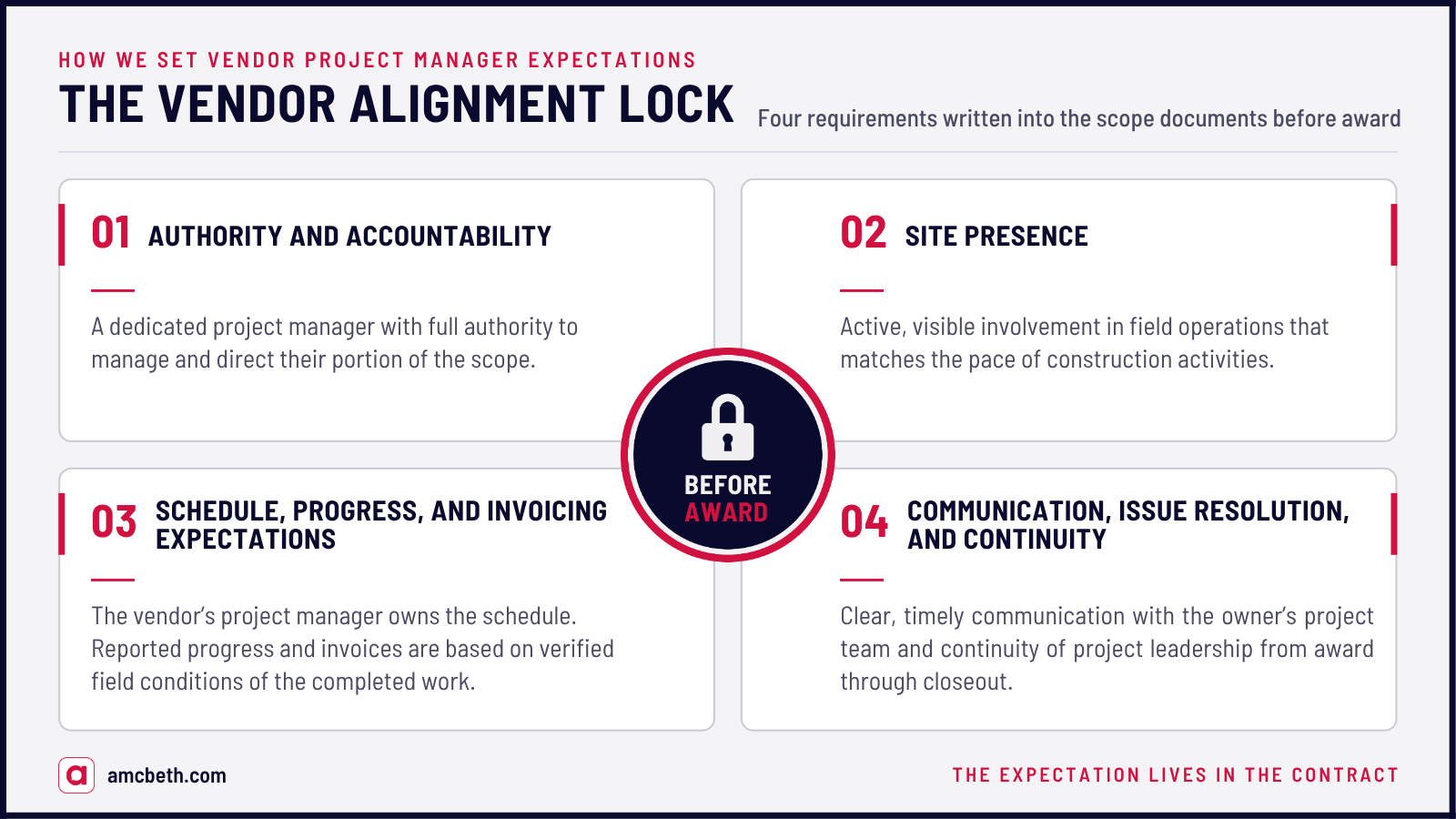
The first requirement is Authority and Accountability. The vendor assigns a dedicated project manager with full authority to manage and direct their portion of the scope. That person decides on site and is empowered to make timely calls on means, methods, sequencing, and resource allocation without phoning the home office. Primary point of contact. They carry the weight that comes with it.
The second requirement is Site Presence. The vendor’s project manager maintains active, visible involvement in field operations, on site where the crews can find them. During active construction, on-site presence is expected no less than one to two days per week, with more during critical activities. If pace or complexity demands it, we can require more.
The third requirement is Schedule, Progress, and Invoicing expectations. The vendor project manager owns the schedule and keeps working knowledge of the planned sequencing and upcoming activities. Reported progress and submitted invoices are based on verified field conditions of the completed work, which prevents overbilling and the disputes that follow. They engage regularly with their team to confirm actual progress, check installed quantities and crew pace against the plan, and make the owner aware of risks early.
The fourth requirement is Communication, Issue Resolution, and Continuity. Clear, timely communication with the owner’s project team via the appropriate communication method is paramount. This includes escalation of risks and emerging conditions. Issues should be identified and managed before they grow into schedule, cost, or operational impacts.
If the assigned project manager becomes unavailable or fails these expectations, the vendor provides a qualified replacement with equivalent authority and project knowledge that can meet the owner’s expectations. That replacement clause is how the owner stays protected when the vendor project manager changes mid-project. Without it, the person who sat in the pre-construction meeting and built the working relationship can leave mid-project, and the next person starts from zero. Putting that in the contract doesn’t stop the workforce turnover construction projects keep running into. It reduces the chance that a personnel change costs the owner time.
| Requirement | What It Sets | What Happens Without It |
|---|---|---|
| Authority and Accountability | A dedicated project manager with full authority to manage and direct their portion of the scope. Someone who can decide on site the same day. | Decisions stall because the vendor’s point of contact doesn’t have standing to make them. |
| Site Presence | Active, visible involvement in field operations during active construction. No less than one to two days per week, with more during critical activities. | Progress reporting runs on assumptions about the field. |
| Schedule, Progress, and Invoicing expectations | The vendor’s project manager owns the schedule. Reported progress and invoices are based on verified field conditions of the completed work. | Invoices don’t match the work that has been completed. Schedule slippage warning signs go unnoticed. The owner loses visibility into where the project actually stands. |
| Communication, Issue Resolution, and Continuity | Clear, timely communication with the owner’s project team via the appropriate method, including escalation of risks and emerging conditions. Issues identified and managed before they grow into schedule, cost, or operational impacts. | Issues sit unresolved. Risks reach the owner late. |
What Do You Check Before You Award the Vendor?
Before awarding a contract that depends on a vendor project manager to deliver, apply the Vendor Alignment Lock:
- Authority and Accountability. Write it into the scope. The vendor’s project manager must be able to decide means, methods, sequencing, and resource allocation without escalating to the home office.
- Site Presence. Require it during active construction. Set the minimum and reserve the right to increase it based on complexity, phase, or performance.
- Schedule, Progress, and Invoicing expectations. Tie progress reporting and invoicing to verified field conditions of the completed work. The vendor’s project manager owns the schedule, and reported progress must reflect the work actually in place.
- Communication, Issue Resolution, and Continuity. Require clear communication with the owner’s project team, and include a replacement provision so a mid-project personnel change doesn’t cost the owner time.
We spent enough years learning this the hard way. Too many hours spent chasing alignment with a vendor project manager when it could have been written into the contract from the start. Eventually we stopped hoping for it and started requiring it. The requirements in our scope documents aren’t bureaucratic language. They’re how we stop spending project management hours on something that should have been settled before mobilization.
How Do You Put This to Work?
Who. The owner’s project manager (owner’s representative), working with the teammate that writes the scope documents.
When. Before proposals go out, and again before award to confirm expectations (pre-award).
What a good vendor project manager does.
- Before award, they are named on the project org chart in the proposal, often with resumes showing relevant work. If the project calls for a pre-award interview, they attend.
- They show up at the pre-construction meeting with their superintendent and foreman. They also take an active part in pre-construction submittals.
- They are on site as the RFP requires, typically at least one to two days a week during active construction, more during critical work.
- They take part in project briefs that tie progress to invoices, such as daily calls, weekly reports, and monthly billing reviews.
- They identify scope changes in writing before the work is done, not on the invoice.
- They call you about a risk the same day they see it, and answer within a reasonable time frame.
Where you set it. Write the requirements in the RFP so the vendor understands the time commitment of their project manager prior to submitting a bid. Walk through the expectations again at the pre-construction meeting.
Early warning signs.
- The person on site isn’t the one on the org chart, and the vendor never notified the owner.
- Responses are habitually late.
- Invoices run ahead of the actual work completed in the field.
- You hear about problems after they cost the project.
What you do then. Raise it with the vendor’s project manager in writing and point to the contract language. If it doesn’t change, take it to their leadership. If it still doesn’t change, mandate a replacement.
Think First. Execute Strong.
Why does the vendor project manager matter so much when the owner doesn’t carry in-house crews?
When the owner doesn’t carry in-house crews, the responsibility for directing the work in the field lands on the vendor project manager. That person has more direct control over executing the deliverable than anyone on the owner’s side. If alignment is off, the owner’s project manager spends the job managing the relationship instead of the work.
What is the Vendor Alignment Lock?
The Vendor Alignment Lock is the discipline of defining what the vendor’s project manager must deliver, how they must be present, and what happens when the standard isn’t met, before the contract is awarded. The requirements go into the scope documents so the vendor knows the expectation before submitting a proposal. The expectation lives in the contract, not the conversation.
What happens when vendor project manager alignment is missing?
Invoices get paid for work that is still unfinished, and the as-builts fall weeks behind the job. The owner’s project manager spends more time managing the relationship than managing the deliverable. That is time the project can’t afford.
How do you set vendor project manager expectations into the contract before award?
Write the requirements into the scope before the vendor is awarded. Cover authority and accountability, site presence during active construction, schedule and invoicing based on completed work, and clear communication with the owner’s team. Include a replacement provision so a mid-project personnel change doesn’t cost the owner time.
Why include a replacement clause for the vendor’s project manager?
If the assigned project manager becomes unavailable or fails the expectations, the vendor provides a qualified replacement with equivalent authority and project knowledge that can meet the owner’s expectations. Without that clause, the person who built the working relationship can leave mid-project and the next person starts from zero. Putting it in the contract doesn’t stop turnover. It reduces the chance that a personnel change costs the owner time.
When vendor project manager alignment is left to conversation instead of the contract, the owner pays in invoices that don’t match the work and hours spent managing the relationship instead of the deliverable. That is an owner-side control failure, and it starts before award. Owner’s representation and project control is how we write the Vendor Alignment Lock into scope before proposals, more on how A. McBeth works.
