


When a contractor’s field crew arrives on site without a clear briefing on what they’re doing, the project absorbs every minute they spend figuring it out, and the cost goes beyond lost hours. The fix is a short briefing before anyone touches the work, covering scope, sequence, site constraints, who to call, and what to report at the end of the day. An unbriefed crew makes decisions on the fly, in spaces they may not fully understand, without direction on routing, boundaries, or escalation. Contractor field communication between the project manager who priced the work and the crew doing the work is a gap that surfaces on project after project, and it’s one of the cheapest problems to fix.
We watched it happen again.
What Happens When Contractor Field Communication Breaks Down?
An electrical contractor was brought in to extend a security camera network, running fiber, network cabling, and power to support a new camera location. We had walked the job with the contractor’s project manager weeks earlier. Every cable path, endpoint, and termination point was identified. He came back with a price, we agreed on it, and the work was scheduled.
The day of, the crew showed up without the project manager, not unusual for a small job. Before they walked out to the job location, we sat down in the office to go through the game plan. The crew knew the general assignment: run cable. The details were a different story. The specific routing, the endpoint locations, where the network switch was going, how the new runs tied into the existing infrastructure. That level of direction hadn’t traveled from the estimate to the field.
The crew had the material in hand, fiber and network cable, and without the details, the job was about to get reengineered in the field when it had already been worked through at the estimating table. So we got the project manager on the phone and asked him to walk his crew through the scope before they started.
The crew left the office, and the project manager walked the field team through a detailed scope conversation on their own. Twenty minutes later, the crew came back to the office with direction. The routing and approach were clear. Instead of standing in front of an electrical panel trying to reverse-engineer the job from the materials in hand, the field team had a plan and moved on it.
Twenty minutes is all it took. And that gap, between the contractor’s project manager who priced the work and the crew who showed up to execute the work, saved an estimated hour and a half to two hours of field time on a small crew, on a fairly straightforward job. Scale that across a project with multiple subs mobilizing over weeks or months, and the hours buried in unbriefed crews don’t stay small. They compound into idle crews and rework, and the schedule slips without anyone tracing it back to the briefing that didn’t happen.
What Should a Pre-Work Briefing Actually Cover?
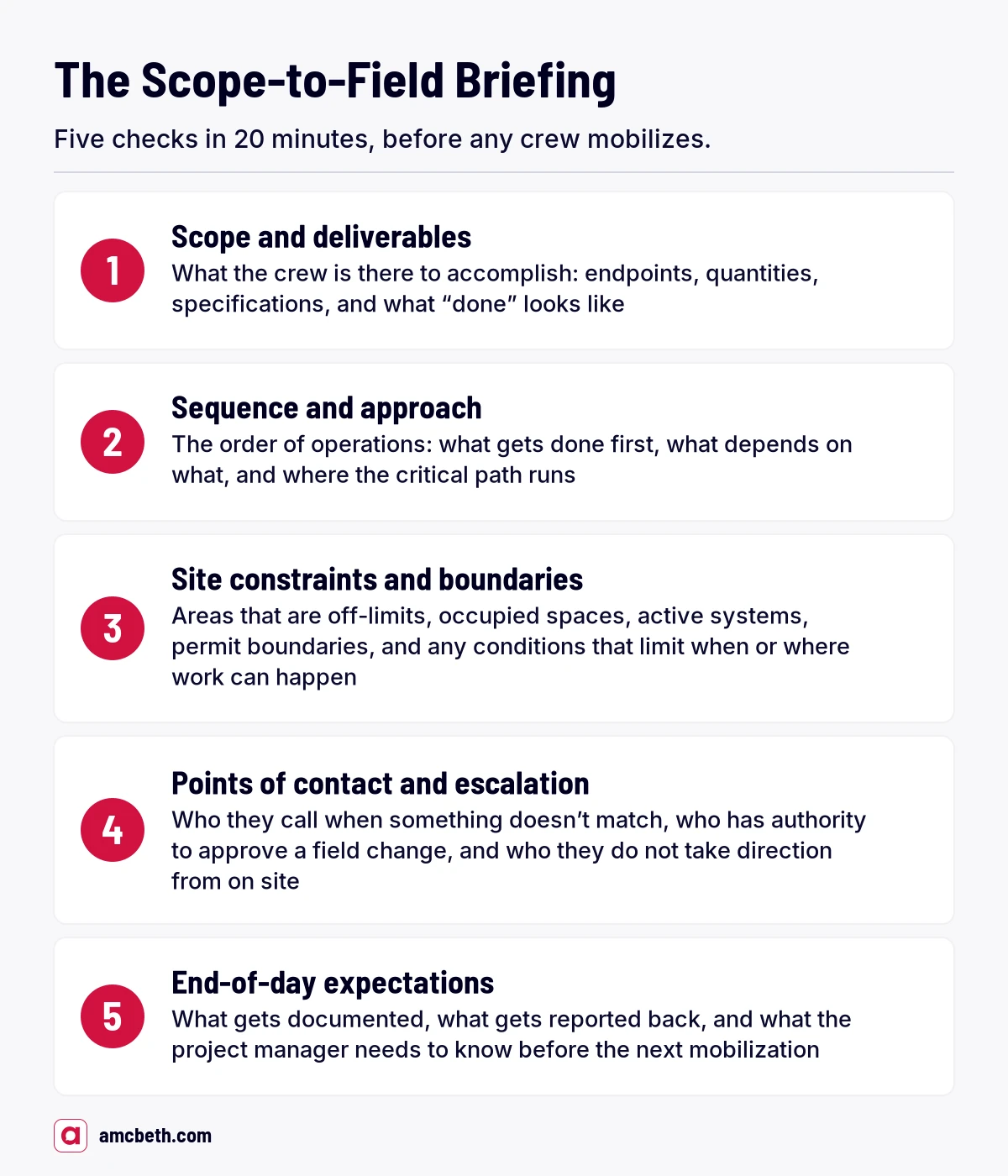
The briefing itself isn’t complicated. Making it happen before each crew mobilizes is the part that often falls off. The table below is what we walk through before any crew touches the work, whether it’s a two-person cable pull or a nine-person excavation team.
| Briefing Element | What to Confirm | What It Costs If Missing |
|---|---|---|
| Scope and deliverables | What the crew is there to accomplish: endpoints, quantities, specifications, and what “done” looks like | A crew without a defined end state will build toward their best guess. Their best guess costs more than a briefing. |
| Sequence and approach | The order of operations: what gets done first, what depends on what, and where the critical path runs | Crews working out of sequence create rework. A cable run terminated before the switch location is confirmed is a cable run that might get pulled twice. |
| Site constraints and boundaries | Areas that are off-limits, occupied spaces, active systems, permit boundaries, and any conditions that limit when or where work can happen | A crew figuring out constraints on the fly doesn’t just waste time. They make field decisions about access and routing that the project manager should be making. That’s where safety exposure starts. |
| Points of contact and escalation | Who they call when something doesn’t match, who has authority to approve a field change, and who they do not take direction from on site | Without a clear escalation path, the crew either stops and waits, burning hours, or makes a judgment call that may not align with the project scope. |
| End-of-day expectations | What gets documented, what gets reported back, and what the project manager needs to know before the next mobilization | If the project manager doesn’t know what happened today, tomorrow’s plan is built on assumptions. |
This is what we call the Scope-to-Field Briefing: the discipline of confirming that the scope knowledge held by the person who priced the work has been transferred to the crew executing it before they touch the work. It works as a checkpoint: can the field crew articulate the scope, sequence, constraints, contacts, and end-of-day expectations before they start? If the answer is no, the briefing hasn’t happened, regardless of what was discussed in the truck on the way to the site.
Before any crew mobilizes, we ask the foreman to walk the job back to us. If they can’t (scope, sequence, constraints, contacts, reporting), the crew doesn’t start. That’s the test. A crew asking basic scope questions at the job location means the Scope-to-Field Briefing never happened.
When the scope is known, like the camera network extension, the Scope-to-Field Briefing defines the end result. But not every job starts with a clear picture. Sometimes you’re opening electrical panels, tracing unmarked wiring, or excavating to locate utilities that couldn’t be found above ground. In exploratory work, the briefing defines the process instead: start here, dig back twenty feet, if you don’t find anything, stop and call before you keep going. Either way, the crew leaves the briefing with direction, not a blank slate.
The briefing also needs to be confirmable. A verbal walkthrough that happened in the truck on the way to the site is not the same as a documented exchange the project manager can point to. When the “he said, she said” starts (and it will), the real question is whether anyone can prove the briefing happened.
Why Does This Keep Happening, and What Do You Do About It?
The pattern is familiar. The contractor’s project manager walks the job, prices the work, and owns the scope in their head. That walk only helps if the drawings were validated against the field before the job was priced. But that knowledge doesn’t transfer to the crew automatically. Somewhere between the estimate and the mobilization, the briefing either gets shortened, assumed, or skipped entirely. The crew shows up with material and a general idea. The rest gets figured out in the field, at field rates.
We’ve stopped waiting for it to happen on its own. On our projects, whoever the contractor is, we sit down with the crew or their foreman, the crew’s team lead, before they start. Not because it’s our job to brief another company’s employees, but as the owner’s project manager, a contractor’s process gaps become project gaps. A crew working without direction burns paid hours and takes on risk that didn’t need to be there. We do it for efficiency: get them in, get them out, especially on time-and-material work. And we do it for safety: a crew working without a clear plan is a crew deciding on its own which panel to open or which wall to drill through, in spaces they may not fully understand.
When it happens, the feedback goes up the chain, not to the crew. The conversation is direct: here’s what we experienced, here’s what it cost, and here’s what would have prevented it. What goes on internally to their company is their business. But that field experience gets reported back to the contractor’s leadership. Often, the response is genuine appreciation, because their leadership doesn’t always see what’s happening at the crew level, and for a contractor trying to protect their margins, a tighter briefing process is something they can act on tomorrow.
The frustrating part is that a twenty-minute phone call was all it took to fix, and that gap shows up on projects more often than it should. The Scope-to-Field Briefing is the process that prevents it:
- Before any crew mobilizes, confirm that the contractor’s project manager has conducted the Scope-to-Field Briefing with the field team (covering scope, sequence, constraints, contacts, and end-of-day reporting), or brief them yourself at the site before work begins.
- When the scope is defined, the briefing locks the end result. When the scope is exploratory, the briefing locks the process: start point, method, stopping conditions, and who to call before proceeding.
- Make the briefing confirmable. A verbal walkthrough that can’t be referenced later is only a conversation that may or may not have happened.
- When an unbriefed crew shows up, give direct feedback to the contractor’s project manager and their leadership, not the field workers. The gap is upstream. The fix is upstream.
The work had already been walked. The scope had already been priced. The only thing missing was making sure the people doing the work knew what the people who priced the work had already figured out. That is a contractor field communication gap, and pressure-testing whether the Scope-to-Field Briefing actually exists before crews mobilize is the difference between a pre-construction coordination plan and a hope.
How Do You Put This to Work?
Who. The owner’s project manager (owner’s representative), working with the contractor’s project manager.
When. On smaller jobs with no formal pre-construction meeting, the Scope-to-Field Briefing usually takes its place. The contractor’s project manager reviews the scope with their crew before work starts. On larger jobs with more stakeholders, the owner’s project team facilitates the pre-construction meeting with key team members.
What a good contractor project manager does. They hold a Scope-to-Field Briefing with their crew before work starts. A good briefing covers:
- The scope: what the crew is building and the limits of construction.
- The sequence: what gets done first, and what has to wait on someone else.
- The constraints: site rules, access, work hours, and anything that can’t be shut down.
- Stop conditions: what the crew does when the field doesn’t match the drawings, and who they call before going on.
- Contacts: who the foreman calls on the contractor’s side and on the owner’s side.
- End-of-day reporting: what the crew reports back, and to whom.
A good contractor project manager also writes the briefing down and sends it before the crew starts, and briefs new people when a crew or foreman changes.
Where you set it. Write the expectation for the job into the RFP so the contractor prices the right one: a Scope-to-Field Briefing on a smaller job, or an owner-facilitated pre-construction meeting on a larger one.
Why we set it there. A contractor prices what the RFP asks for. If the briefing isn’t in the RFP, it’s time the contractor didn’t carry, and it’s the first thing cut when the schedule gets tight, because time is money. Every project is different, so the RFP and the contract set the expectation for that project.
Early warning signs.
- The foreman on site isn’t the one on the org chart, and the contractor didn’t tell you.
- The written briefing record shows up after the work starts, or not at all.
- Field change requests come from the crew instead of the contractor’s project manager.
- Time-and-material hours run high because the crew isn’t working efficiently.
What you do then. Raise it with the contractor’s project manager in writing and point to the contract language. If it doesn’t change, take it to their leadership. If it still doesn’t change, hold the next crew until the briefing is done and written down.
Think First. Execute Strong.
Why do contractor field crews show up without knowing the full scope of work?
The scope knowledge stays with the contractor’s project manager who priced the work and doesn’t transfer to the field crew automatically. Somewhere between the estimate and mobilization, the pre-work briefing gets shortened, assumed, or skipped. The crew arrives with materials and a general assignment, and the details (routing, endpoints, constraints, escalation paths) get worked out in the field at field rates instead of in a twenty-minute briefing beforehand.
What is the Scope-to-Field Briefing?
The Scope-to-Field Briefing is the discipline of confirming that the scope knowledge held by the person who priced the work has been transferred to the crew executing it before they touch the work. It covers five elements: scope and deliverables, sequence and approach, site constraints and boundaries, points of contact and escalation, and end-of-day expectations. If the field crew can’t articulate those five elements before starting, the briefing hasn’t happened.
How much time does an unbriefed contractor crew waste on a project?
On a single small job (a two-person cable pull), the gap between the project manager’s scope knowledge and the crew’s understanding cost an estimated hour and a half to two hours of field time. A twenty-minute phone call resolved it. Scaled across a project with multiple contractors mobilizing over weeks or months, unbriefed crews lead to idle time and rework, and the schedule slips without anyone tracing it back to the missing briefing.
What should a contractor pre-work briefing cover before crews mobilize?
The briefing should confirm five elements: scope and deliverables with a defined end state, sequence and approach including the order of operations and critical path, site constraints and boundaries including off-limits areas and active systems, points of contact and escalation with named decision-makers, and end-of-day expectations for documentation and reporting. When the scope is defined, the briefing locks the result. When the scope is exploratory, the briefing locks the process.
Who is responsible when a contractor crew arrives on site without a briefing?
The gap is upstream: between the contractor’s project manager who priced the work and the field crew. Feedback goes to the contractor’s PM and their leadership, not to the crew. As the owner’s project manager, a contractor’s process gaps become project gaps, so conducting or confirming the Scope-to-Field Briefing before work begins is a project management step the owner still needs, regardless of whose responsibility it should be.
When the crew shows up without the game plan, the owner pays for a contractor process gap. That is an owner-side control problem, not a toolbox problem. Owner’s representation and project control is how we pressure-test Scope-to-Field Briefings before mobilization. More on how A. McBeth works.
